Trying to decide between a townhouse or a condo in Sunnyvale? You want the right mix of space, low maintenance, and a smart financial move, but the terms and trade-offs can get confusing fast. This guide breaks it down in plain English so you can choose what fits your life today and supports your goals tomorrow. You will learn key differences, what to check in HOAs, how financing really works here, and how each option tends to resell in Sunnyvale. Let’s dive in.
Townhouse vs. condo basics
A townhouse is a style. A condominium is a legal form of ownership. In Sunnyvale, many homes marketed as “townhomes” are legally condominiums. That legal form controls who maintains what, how insurance works, and how lenders evaluate the property.
Here is what that means for you:
- Ownership and land
- Fee-simple (often called PUD or a townhome with land): You usually own the land under your unit. This can feel more like a single-family home.
- Condominium: You own the interior of your unit and a shared interest in common areas. The HOA manages most exteriors and shared elements.
- Exterior and roof responsibility
- Condos: The HOA typically maintains and insures exterior walls and roofs.
- Fee-simple townhomes: You may be responsible for exterior and roof. Always verify in the CC&Rs.
- Insurance
- Condos: You usually carry an HO-6 policy for the interior. The HOA has a master policy. Confirm if the master policy is “walls-in” or “all-in,” as this affects your coverage.
- Use rights and rules
- Patios, yards, parking, storage, pets, and rental policies are controlled by recorded CC&Rs and HOA rules, not by the marketing label.
Checklist to confirm legal form and responsibilities:
- Review the deed and CC&Rs to confirm fee-simple vs condominium.
- Ask who maintains the roof, exterior, balconies, fences, and patios.
- Verify master insurance type and your HO-6 needs.
- Confirm rental caps, pet rules, parking assignments, and storage.
How these homes fit in Sunnyvale
Sunnyvale’s location in the South Bay makes attached housing popular. Proximity to major employers and transit means demand is steady among tech professionals, couples without kids, and young families.
- Where condos tend to be: Higher-density buildings and older low-rise complexes often cluster near downtown Sunnyvale, transit corridors, and shopping.
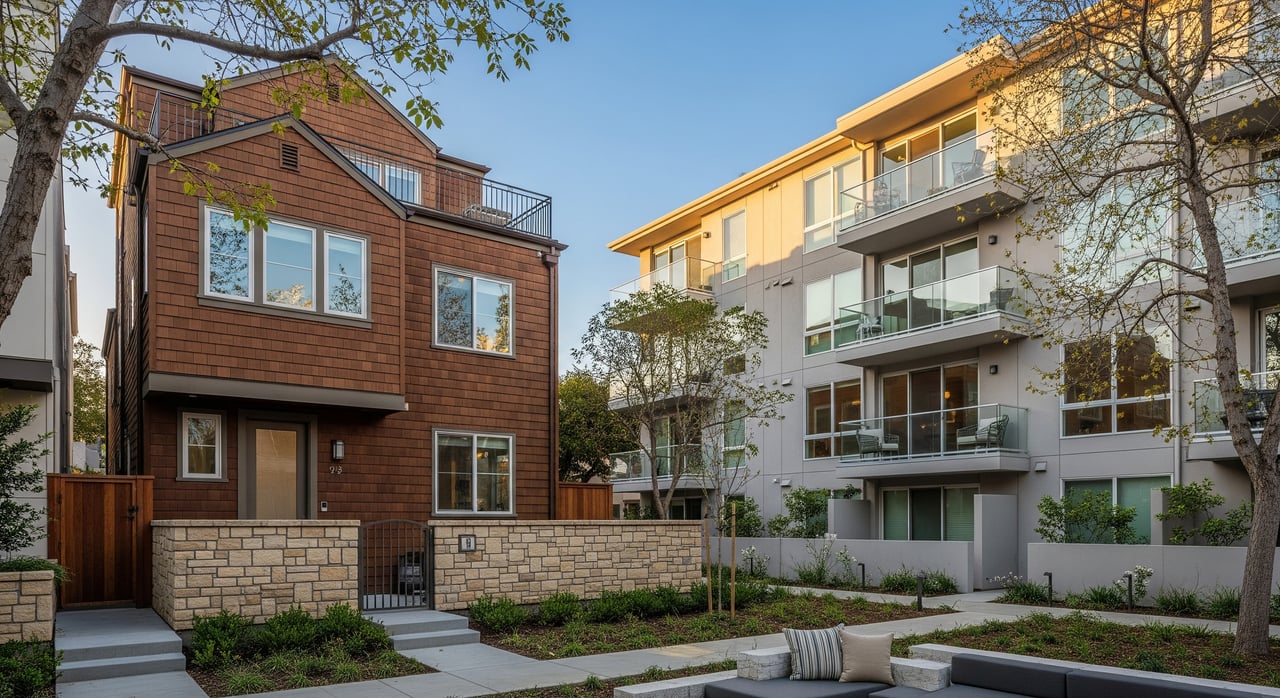
- Where townhomes tend to be: Newer subdivisions and infill areas, sometimes with lower parcel density and more garage or yard space.
- Who they serve:
- DINKs and young professionals often prioritize commute time, lock-and-leave convenience, and shared amenities.
- Young families often want more bedrooms, a garage, and private outdoor space, which townhomes commonly provide.
Space and layout
Space and separation can drive your decision.
- Typical layouts
- Condos often have single-level living with efficient floor plans.
- Townhomes often have multiple levels, with living areas on the main floor and bedrooms upstairs.
- Outdoor space and storage
- Fee-simple townhomes more often include private yards or larger patios.
- Condos typically offer balconies and shared courtyards; storage may be limited to lockers.
- Noise and privacy
- Attached homes share walls. In older condo projects, sound transfer can be more noticeable. Ask about insulation, double-stud walls, and any prior noise complaints.
Space-focused tour checklist:
- Count bedrooms, bathrooms, and check closet capacity.
- Note sun exposure and floor level; confirm elevator access if needed.
- Identify storage areas, garage type, and assigned parking.
- Ask where interior ends and common elements begin, especially for patios or yards.
HOA, fees, and maintenance
An HOA can simplify upkeep, but the details matter.
- What HOA fees may cover
- Exterior maintenance, landscaping, common-area repairs, building insurance on the master policy, trash, some shared utilities, and amenities like a pool or gym.
- Reserves and special assessments
- Strong reserves reduce surprise costs. Older complexes may face near-term projects such as roof replacement, siding, or seismic work. Ask about prior or planned special assessments.
- Insurance clarity
- Confirm if the HOA’s master policy is walls-in or all-in. If walls-in, you may need broader HO-6 coverage.
- Governance health indicators
- Review recent meeting minutes, delinquency rates, reserve studies, management turnover, and any litigation.
Documents to request before writing an offer:
- CC&Rs, Bylaws, Rules and Regulations
- Current budget, last 2–3 years of financials, and the latest reserve study
- Insurance certificate and coverage summary
- Minutes from the last 12 months
- Delinquency report and any pending litigation disclosures
On-site HOA check:
- Observe roof, siding, balconies, paint, and landscaping condition.
- Ask what the monthly fee includes and if increases are planned.
- Confirm any pending projects or assessments.
Amenities and lifestyle
Think about how you will live day to day.
- Amenities trade-offs
- Condos often offer pools, gyms, and shared workspaces that appeal to busy professionals.
- Townhomes may have fewer shared amenities but offer private outdoor space and garages.
- Commute and access
- Proximity to Caltrain, VTA, and major employer campuses adds convenience and broadens your future buyer pool.
- Schools, parks, and services
- If you have or plan for kids, verify school boundaries for your exact address and consider closeness to parks and playgrounds.
- Parking and EV readiness
- Confirm assigned spaces, guest parking rules, and EV charging policies and infrastructure.
Financing realities in Sunnyvale
Your financing path can depend on the property’s legal form and the project’s profile.
- Fee-simple townhomes
- Usually qualify for standard conventional loans without condo project reviews.
- Condominiums
- May require a lender’s project approval, often called warrantability for Fannie Mae or Freddie Mac. Factors that can complicate approvals include low owner-occupancy, high investor concentration, large commercial components, inadequate reserves, litigation, high delinquencies, or a single entity owning many units.
- FHA and VA
- Some condo projects require FHA or VA approval. Non-approved projects can limit options. Ask your lender to verify approval status early.
Financing steps to take now:
- Get pre-qualified with a lender experienced in Bay Area condos and townhomes.
- Have your agent obtain legal form, HOA contact, budget, reserve study, and insurance info for your lender.
- If the project is non-warrantable, discuss down payment, rate, and portfolio loan options upfront.
Resale and long-term value
Think about the future buyer for your place.
- Who buys what
- Condos: first-time buyers, downsizers, singles or couples, and sometimes investors subject to HOA leasing rules.
- Townhomes: buyers seeking more space, often families or those moving up from condos.
- Value drivers
- Proximity to transit and employment centers, healthy HOA reserves, sound management, parking, and a track record of comparable sales.
- Risks to watch
- Non-warrantable status that limits buyer financing, looming special assessments, litigation, weak reserves, and high delinquencies.
Measure the market when you are ready:
- Review recent comparable sales, days on market, and months of supply for Sunnyvale condos and townhomes.
- Compare price per square foot and any differences in appreciation trends between styles.
Quick decision guide
Use this simple flow to narrow your fit:
- If you want low-maintenance living, shared amenities, and walkability to downtown or transit, start with condos.
- If you want multi-level living, a garage, and private outdoor space that feels closer to a single-family home, start with townhomes.
- If financing flexibility is crucial, fee-simple townhomes may simplify lending.
- If your budget is tight and location is priority, condos can offer strong value near hubs.
Signals a condo may fit you:
- You prefer smaller, single-level spaces and on-site amenities.
- You value proximity to transit, shops, and restaurants.
- You are comfortable with the HOA controlling exterior elements and common areas.
Signals a townhouse may fit you:
- You want more bedrooms, separation of spaces, and a private garage.
- You like the feel of fee-simple ownership or a layout closer to a single-family home.
- You can take on a bit more maintenance, depending on the legal form.
Pre-tour checklist
Legal and financial:
- Confirm fee-simple (PUD) vs condominium and request recording or plat details.
- Ask for CC&Rs, bylaws, rules, current budget, reserve study, minutes, insurance certificate, and financials.
- Clarify HOA dues, what they include, and any planned or pending assessments.
- Ask about reserve balance, delinquency rate, and any litigation.
Unit specifics:
- Who maintains roof, exterior, balconies, decks, and fences?
- Assigned parking count, storage options, and garage access.
- Any known water intrusion, pest history, or structural repairs.
- Age and condition of HVAC, water heater, plumbing, and electrical.
Financing:
- Ask whether the project meets conventional warrantability standards.
- Verify FHA or VA approval status if relevant to your loan.
Lifestyle:
- Pet policies, rental caps, guest parking, and EV charging.
- Walkability to transit, parks, groceries, and services you use.
Neighborhood and local costs:
- Ask about any Mello-Roos or special parcel taxes; confirm on the property tax bill.
On-tour inspection checklist
- Interior: check for stains, cracks, or odors; inspect under sinks; confirm appliance and system ages.
- Exterior/common: look at roofs, siding, paint, balcony flashings, and drainage patterns.
- Sound: listen for hallway and adjacent unit noise; note floor squeaks and ceiling noise transfer.
- Parking and storage: test garage doors, find assigned spaces, and locate guest parking.
- Walk the area: observe commute-hour traffic, access to transit, parks, and daily conveniences.
Red flags to pause on
- Pending litigation involving the HOA or project.
- Low reserves relative to upcoming capital needs.
- History of frequent special assessments without long-term fixes.
- High delinquency rates or notable turnover in the management company.
- Non-warrantable condo status that limits buyer financing.
- Single-entity ownership concentration within the project.
- Visible deferred maintenance on roofs, siding, balconies, or garages.
- No assigned parking or limited guest parking for the unit count.
Next steps
Choosing between a townhouse and a condo in Sunnyvale comes down to how you live, how you want to maintain your home, and how you plan to finance and resell. The best next move is to pair your priorities with a clear review of the legal form, HOA strength, and project-level financing. With the right prep, you can buy confidently and enjoy the lifestyle you want.
If you want a local guide who blends market knowledge with financing savvy, connect with Amy Le. With 20+ years in Santa Clara County and a background in mortgage and income-tax matters, we can help you review HOA documents, coordinate lender requirements, and compare options so you choose the home that truly fits.
FAQs
What is the key difference between a townhouse and a condo in California?
- A townhouse is a building style, while a condo is a legal form of ownership that defines what you own and what the HOA controls.
How do HOA fees typically differ for Sunnyvale condos vs townhomes?
- Condo fees often cover more exterior maintenance and amenities, while fee-simple townhomes may have lower dues but more owner responsibility; always verify inclusions.
Can I use FHA or VA financing to buy a Sunnyvale condo?
- Possibly, but many condos require FHA or VA project approval; check approval status with your lender early in the process.
What makes a condo project non-warrantable for conventional loans?
- Common triggers include low owner-occupancy, high investor share, inadequate reserves, significant litigation, or high delinquencies within the HOA.
Which tends to offer more space and storage, a condo or a townhouse?
- Townhomes more often provide multi-level living, a garage, and private outdoor space, while condos emphasize efficient, often single-level layouts.
What HOA documents should I review before making an offer?
- Ask for CC&Rs, bylaws, rules, current budget, 2–3 years of financials, the latest reserve study, minutes, insurance certificate, delinquency report, and any litigation disclosures.
How do special assessments affect owners in older complexes?
- Special assessments can add significant, time-bound costs for projects like roofing or seismic upgrades; review reserve studies and minutes to gauge risk.